Categories
News about VDES

NCSR 13: Outcomes relevant to VDES

The 13th session of the IMO Sub-Committee on Navigation, Communications and Search and Rescue (NCSR 13) met from 22 to 26 June 2026. Its report to the Maritime Safety Committee (NCSR 13/18, with annexes in NCSR 13/18/Add.1) records several outcomes that touch VDES directly.

  • A performance standard for shipborne R-mode

NCSR 13 agreed a draft MSC resolution on performance standards for shipborne R-mode receiver equipment (Annex 11), forwarded to MSC 112 with a view to adoption. The standard is explicit that VDES is one of R-mode’s two carriers: VHF R-mode signals are transmitted as part of VDES on its specific channels, alongside medium-frequency broadcasts in the 283.5 to 325 kHz band. It covers the basic functional requirements of position fixing, determination of course over ground, speed over ground, and timing. The Sub-Committee agreed that R-mode should serve as a backup supplementary to GNSS, and that amending the Worldwide Radionavigation System resolution (A.1046(27)) to formally incorporate R-mode would be premature at this stage.

  • WRC-27: protecting maritime spectrum

NCSR 13 finalised the draft IMO position on ITU WRC-27 agenda items concerning maritime services (Annex 6), for approval by MSC 112 and submission into the ITU process, with the final position to be prepared by NCSR 14. The work is directed at protecting GMDSS and maritime radio services in the coming spectrum negotiations, and includes new allocations to support the implementation of R-mode in the VHF maritime mobile band.

  • An S-100 connectivity framework

NCSR 13 agreed a draft MSC circular on guidance to establish a framework for data distribution and global IP-based connectivity for shore-based facilities and ships supporting ECDIS S-100 products (Annex 8), also going to MSC 112. IALA recommended that the framework use the Secure Communication between ship and shore (SECOM) infrastructure and the Maritime Connectivity Platform (MCP) as the reference solution for secure communication, identity, trust and service discovery. The Maritime Messaging Service (MMS) is referred to as an optional technology in the guidance. The circular does not designate VDES as an S-100 transport and imposes no carriage requirement on ships.

  • LRIT under discussion

NCSR 13 recorded a discussion of Long-Range Identification and Tracking (LRIT). Several delegations pointed to the declining use of LRIT for search and rescue and to the availability of competing technologies. Separately, MSC 111 has approved a move to a free-of-charge policy for the provision of LRIT information to entitled coastal States. This is relevant to VDES because, with authentication, VDES can provide the same function and considerably more.

  • GMDSS resilience

Several administrations raised concerns at NCSR 13 about the practical accessibility of satellite GMDSS services, including service limitations imposed for non-technical reasons. IMSO reported that even on affected terminals, GMDSS services remained available in line with the applicable resolution. VDES, as a potential future GMDSS technology, is an open standard, allowing multiple countries to implement complementary, compatible solutions with sufficient redundancy to mitigate the potential impact of commercial or political conflicts on safety of navigation services.

  • Position quality: DFMC SBAS and ARAIM

NCSR 13 advanced work on performance standards for dual-frequency multi-constellation satellite-based augmentation systems (DFMC SBAS) and advanced receiver autonomous integrity monitoring (ARAIM) in shipborne radionavigation receivers, re-establishing a correspondence group to finalise the standards for NCSR 14. This work improves position quality, including in regions where GNSS interference degrades AIS and VDES position reporting.

In summary

VDES remains complementary to the work of IALA, ITU, IMO, IEC and RTCM rather than a replacement for any of it. NCSR 13 is a useful marker of how far the groundwork has come, and Alliance members are building the equipment that turns these standards into working systems at sea. The full report is available as NCSR 13/18 and its addendum NCSR 13/18/Add.1 at https://docs.imo.org.

VDES Alliance Contributing Members can access the referenced annexes through the VDES Alliance Contributing Members SharePoint.
Categories
Events

Meet VDES Alliance Members at SMM 2026

SMM 2026 opens in Hamburg from 1 to 4 September, and a number of VDES Alliance members will be there. If you want to talk VDES, vessel tracking, or maritime data in person, here is who to look out for!

On the show floor with a stand:

Lloyd’s List Intelligence — Hall B8, Booth 130

Pole Star Global — Hall B6, Stand 336

Teledyne FLIR Transponder Tech — Hall B6, Stand 305

Also attending SMM 2026:

LusoSpace, ArkEdge Space, and EOS Orbit will be at the show without a dedicated stand but ready to connect with you!

If you would like to connect with any of these members or the wider VDES community during SMM, get in touch with the Alliance at administration@vdes-alliance.org and we will help make the introduction.

Categories
Uncategorized

Finnish VDES RFQ

Fintraffic has posted an RFQ for VDES shore stations as part of the NELSON project.

For equipment manufacturers who want to answer the RFQ, please follow to this link.

The VDES Alliance is happy to see that maritime administrations start to actually make e-Navigation a reality by use of VDES, providing a platform for authenticated AIS, GNSS interference reporting and authenticated S-100 based services for VTS and AtoN deployments.

Categories
News about VDES

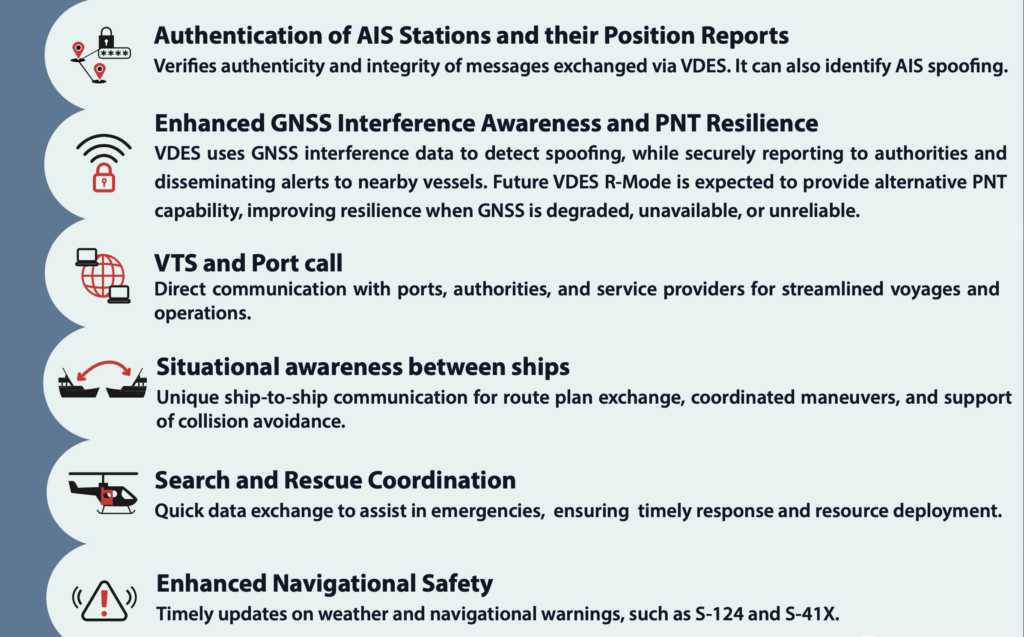
VDES Use Cases

The VDES Alliance in one of its Working Groups identified the most relevant use cases for VDES, and we want to share these with you prior to presenting them at IMO NSCR13 here.

Harmonization of how to implement these use cases, is part of the work at many organizations:

  • IEC in its DRAFT Equipment Standard 63514 3CD describes the authentication of AIS for integrity and authenticity checking, and the authentication of all other VDES messaging. Publication of CDV is expected later in 2026, the international standard is expected in 2027.
  • RTCM has published Standard 13900.0 to explain how S-100 products for enhanced navigational safety, VTS and Portcall can be transferred by the use of VDES using the Maritime Messaging System.
  • IALA works on a shore infrastructure guideline for VDES architecture
  • Numerous projects around the world implement VDES for transport of maritime safety related S-100 modeled data products via MMS and VDE-TER and VDE-SAT.

If you would like to hear more, do not hesitate to reach out to us at administration@vdes-alliance.org.

Categories
News about VDES

IMO adopts VDES as alternative to AIS under SOLAS Chapter V

At its 111th session (MSC 111), the IMO Maritime Safety Committee adopted amendments to SOLAS Chapter V, recognizing VDES as an alternative to AIS for fulfilling minimum carriage requirements. The amendments are set to enter into force on 1 January 2028.

For the maritime community, this is an important step forward. With this decision, VDES has a defined place in the international regulatory framework that governs shipborne navigational systems and equipment. Vessel owners & operators, equipment manufacturers and authorities now have the regulatory certainty needed to move forward with confidence.

VDES builds on AIS rather than replacing it, combining terrestrial and satellite connectivity to deliver affordable, robust, worldwide communication with significantly higher data capacity, two-way data exchange, and global coverage.

The VDES Alliance welcomes this decision and sees it as validation of the work done across the industry – to bring VDES to a point where it earns its place in SOLAS.

Categories
News about VDES

VDES test standard IEC 63514

Following over two years of hard work by the members of IEC TC80 WG15, led by Stefan Bober, and the recent release of ITU-R M.2092-2, the latest version of the VDES mobile station requirements and test standard, IEC 63514 Ed. 1 3CD, is circulated as its third committee draft.

This represents what should be very close to the final version of the standard but provides an opportunity for other IEC TC80 members (administrations, test houses, manufacturers and users) to comment on the detail of the standard and suggest final corrections for the document.

It is expected that the IEC TC80 WG15 later this summer releases the standard to internal voting inside TC80, which then might lead to the status “International Standard” by the end of 2027, if all goes well. 

Based on that international standard, equipment manufacturers may type approve their equipment to actually use VDES equipment for the purposes IMO has identified in the VDES Performance Standard and Guidelines to be adopted by IMO MSC during the opcoming meeting in May 2026.

Many members of the VDES Alliance have collaborated within the IEC TC80 Working Group 15 to produce a set of comprehensive requirements and tests for ASM, VDE-TER and VDE-SAT operation to ensure that equipment conforms to the requirements of ITU and IMO.

Members should consult with their National Committee and keep watch on the IEC TC80 Website for further updates. 

Categories
News about VDES

Successful launch of VDES-related satellites!

On 30 March 2026, a Falcon 9 launch successfully carried a number of satellites into orbit, including missions from the VDES Alliance members – Space Norway and LusoSpace.

This launch marks an important step in strengthening satellite capabilities relevant for future VDES-based services and maritime connectivity more broadly.

With new assets now in orbit, the potential for expanding coverage continues to improve. This is especially relevant for services such as digital maritime safety information and other data-driven applications that rely on reliable communication beyond terrestrial infrastructure.

Lars Løge, VDES Program Manager – Space Norway:

“The successful launch of our new satellite Mimir, with a VDES payload onboard, marks an exiting next step for our satellite VDES developments. The satellite VDES capacity provided by Mimir will enable new maritime services to be developed and operationalised to support the digitalisation of the maritime community for our partners and customers.”

Catarina Nunes, Product Manager for AIS/VDES – LusoSpace

“On 30 March, LusoSpace reached a new milestone – the successful launch of four new satellites equipped with AIS and VDES, joining the PoSat-2, which has been in orbit since January 2025, marks the beginning of the “Lusíada” constellation, which now has five satellites in space.”

From a VDES perspective, it is a solid signal that progress on the satellite side continues, as this remains an important part of enabling global and resilient maritime communication.

The VDES Alliance welcomes the successful launch and looks forward to following the next steps as these systems move towards operational use. If you would like to learn more about VDES or the activities of the Alliance, you are very welcome to reach out via our social media channels or at administration@vdes-alliance.org.

Categories
News about VDES

New VDES RFI

Fintraffic Vessel Traffic Services Ltd is planning a procurement related to the delivery of coastal VDES (VHF Data Exchange System) base stations.

In a first stage made available today, Fintraffic conducts a “Market Dialogue”.

This is very good news for the VDES domain.

Please find more information about the RFI and participation here: link

Categories
Alliance news News about VDES

VDES performance joint testing

In January 2026 Teledyne FLIR TransponderTech and CML Microcircuits performed joined VDES testing in False Bay, South Africa to test the performance of VDES. VDES performed very well and 0% PER was measured over range of 50 km when using link ID 19. Details of the testing will follow in a joint report.

Stay tuned!

Categories
Alliance news Events

VDES Alliance at IALA DTEC6

The VDES Alliance will be present at the upcoming IALA DTEC6 conference, with representation by its newly appointed President, Stefan Pielmeier.

DTEC6 brings together stakeholders across the maritime and navigation community to discuss developments in digital technologies, making it a highly relevant forum for ongoing VDES-related discussions, including standardisation, implementation or operational use cases.

Stefan will represent the Alliance in discussions and exchanges with industry, authorities, as well as Chairman of DTEC WG3, continuing the Alliance’s active engagement in shaping the future of VDES. The participation also marks his first official representation of the Alliance in his new role as President.

If you are attending DTEC6 and would like to discuss anything related to VDES, we encourage you to approach Stefan during the event.